
How to Write a Discharge Summary: Template, Example, and Checklist
The patient goes home on Friday. The follow-up appointment is the next Thursday. Whether that visit goes well often depends on one document: the discharge summary. If it arrives late, or leaves out a medication change or a pending test, the next clinician starts from scratch.
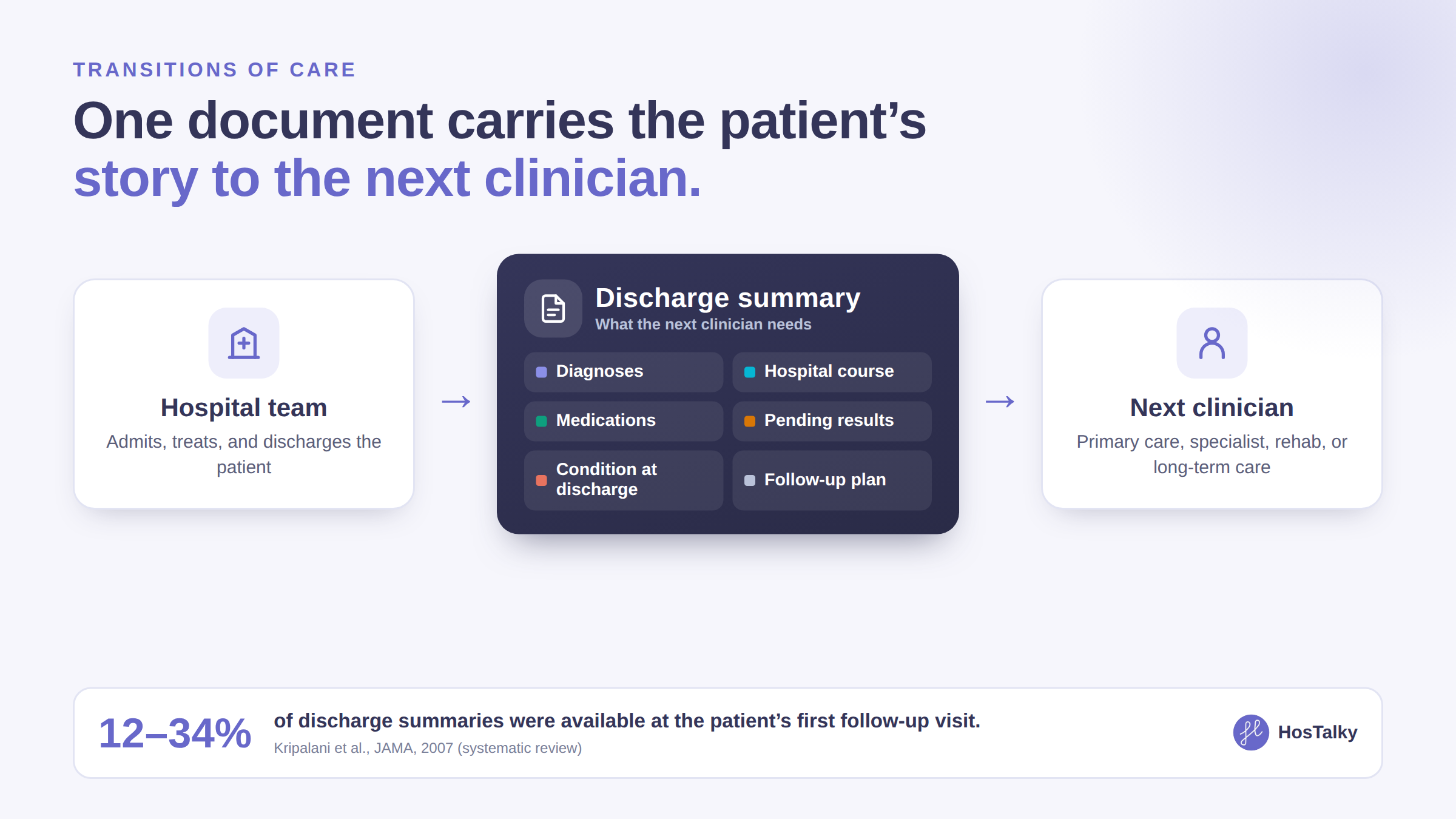
A discharge summary hands a patient’s care from the hospital to the next clinician. Include the reason for admission, diagnoses, hospital course, procedures, reconciled medications, condition at discharge, pending results, and follow-up. Write it on the day of discharge, use a consistent template, and check it against the checklist below.
This guide explains what a discharge summary is, what it must include, and how to write one step by step, with a complete example, a copy-ready template, and a checklist.
What is a discharge summary?
A document that summarizes a hospital stay and hands the patient’s care to the next clinician.
A discharge summary is the clinical record of a hospital admission, written for whoever takes over the patient’s care: a primary care provider, a specialist, a rehabilitation facility, or a long-term care team. It’s usually written by the attending physician or by a resident, nurse practitioner, or physician assistant under their direction.
It’s different from discharge instructions. Instructions are written for the patient, in plain language. The summary is written for clinicians.
Why is the discharge summary important?
It’s the main handoff to primary care, so gaps or delays can lead to missed follow-up and errors.
A widely cited systematic review in JAMA found that discharge summaries were available at the first post-discharge visit in only 12%–34% of cases, and still only 51%–77% at four weeks. That affected the quality of care in about 25% of follow-up visits.
The same review found summaries often left out important information:
- Diagnostic test results: missing from 33%–63%
- Tests still pending at discharge: missing from 65%
- Follow-up plans: missing from 2%–43%
- Discharge medications: missing from 2%–40%
The authors also found that standardized formats improved the perceived quality of discharge summaries, which is exactly what a good template does.
What does a discharge summary include?
Diagnoses, hospital course, procedures, medications, condition at discharge, and follow-up plans.
| Section | What to include | Why it matters |
|---|---|---|
| Patient details | Name, date of birth, admission and discharge dates, attending physician, primary care provider | Identifies the patient and who to contact |
| Reason for admission | Chief complaint and presenting problem | Gives the next clinician context |
| Diagnoses | Principal diagnosis and secondary diagnoses | Defines what was treated |
| Hospital course | A brief narrative of the stay, by problem | Explains what happened and why |
| Procedures and key results | Procedures, significant labs and imaging | Avoids repeat testing |
| Medications | Reconciled list: new, changed, stopped, continued | Prevents medication errors |
| Condition at discharge | Clinical and functional status, and where the patient went | Sets the baseline for follow-up |
| Pending results | Tests not back yet, and who will follow them up | Stops results falling through the cracks |
| Follow-up plan | Appointments, monitoring, who is responsible | Makes the next steps clear |
| Patient instructions | What the patient and family were told | Lets the next clinician reinforce it |
What do the Joint Commission and CMS require?
Both require core elements like the reason for admission, outcome, and plans for follow-up care.
- CMS: under the hospital Conditions of Participation (42 CFR 482.24), medical records must include a discharge summary with the outcome of hospitalization, the disposition of the case, and provisions for follow-up care, and records must be completed within 30 days of discharge.
- The Joint Commission expects the discharge summary to include the reason for hospitalization; procedures performed; care, treatment, and services provided; the patient’s condition and disposition at discharge; information provided to the patient and family; and provisions for follow-up care, as summarized in the HL7 C-CDA discharge summary specification.
Your hospital’s own policy may set stricter rules, such as a shorter completion window. Always check it.
How do you write a discharge summary, step by step?
Start with why the patient was admitted, summarize the stay, reconcile meds, then list next steps.
- Add patient details and dates: name, date of birth, admission and discharge dates, the attending physician, and the primary care provider.
- State the reason for admission and diagnoses: the presenting problem, then the principal and secondary diagnoses at discharge.
- Summarize the hospital course by problem: what was found, what was done, and how the patient responded. Keep it brief; the next clinician needs the story, not every vital sign.
- List procedures and key results: significant labs, imaging, and procedures, with dates.
- Reconcile medications: list every medication as new, changed, stopped, or continued, with the reason for each change.
- Describe the condition at discharge and disposition: clinical and functional status, and where the patient went (home, rehab, long-term care).
- Spell out pending results and follow-up: tests still pending and who will act on them, appointments, monitoring, and who is responsible for each.
What does a discharge summary example look like?
Here’s a complete, fictional example for a patient admitted with community-acquired pneumonia.
Attending: Dr. A. Patel · Primary care provider: Dr. L. Moreno
Reason for admission
Diagnoses
- Principal: Community-acquired pneumonia, right lower lobe
- Secondary: Type 2 diabetes mellitus; hypertension
Hospital course
Procedures and key results
Discharge medications
- NEWAmoxicillin-clavulanate 875/125 mg by mouth twice daily for 2 more days (completes the 5-day course)
- CONTINUEDMetformin 500 mg twice daily; lisinopril 10 mg daily
- STOPPEDNone
Condition at discharge
Pending results
Follow-up
Patient instructions
Is there a discharge summary template you can copy?
Yes. Copy the template below; each heading matches what the next clinician needs to know.
DISCHARGE SUMMARY

Patient name:
Date of birth:
MRN:
Admission date:
Discharge date:
Attending physician:
Primary care provider:

REASON FOR ADMISSION:

DIAGNOSES
  Principal:
  Secondary:

HOSPITAL COURSE (by problem):

PROCEDURES AND KEY RESULTS:

DISCHARGE MEDICATIONS
  New:
  Changed (and why):
  Stopped (and why):
  Continued:

CONDITION AT DISCHARGE:
DISPOSITION (home / rehab / long-term care / other):

PENDING RESULTS (and who will follow up):

FOLLOW-UP PLAN
  Appointments:
  Monitoring:
  Responsible clinician:

PATIENT AND FAMILY INSTRUCTIONS:

Completed by:
Date/time:
Attending signature:
What should a discharge summary checklist include?
Confirm every section, medication change, pending result, and follow-up before you sign.
What mistakes should you avoid in a discharge summary?
Missing medication changes, vague follow-up, unlisted pending results, and summaries sent late.
- Unexplained medication changes: “Lisinopril stopped” without a reason leaves the next clinician guessing whether to restart it.
- Vague follow-up: “Follow up with PCP” doesn’t say when, why, or what to check.
- Missing pending results: these were missing from 65% of summaries in the JAMA review.
- Copying the whole chart: a long, unstructured summary buries the key information.
- Sending it late: a summary that arrives after the follow-up visit can’t help that visit.
How can you write discharge summaries faster?
Document as you go, use a consistent template, and draft from notes you’ve already written.
- Build the summary during the stay, not only at discharge. Update the hospital course as problems resolve.
- Use the same template every time, so you’re filling in sections instead of deciding structure.
- Reconcile medications early, before discharge day.
- Draft from documentation you already have, and check every line before you sign.
HosTalky AI Scribe turns clinical conversations and verbal summaries into structured notes you review and edit before you approve them, so the documentation your summary draws on is already organized.
For more on structured documentation, read SOAP vs. DAP vs. BIRP Notes and How AI Can Help Write SOAP Notes. Handoffs between shifts follow many of the same principles; see our nurse shift handover guide.
Document while it’s fresh
HosTalky AI Scribe turns clinical conversations and verbal summaries into structured notes you review and edit. Free up to 3 notes a day, no credit card required.
Try AI Scribe free →Key Takeaways
- A discharge summary hands a patient’s care from the hospital to the next clinician.
- Include the reason for admission, diagnoses, hospital course, procedures, reconciled medications, condition at discharge, pending results, and follow-up.
- CMS requires a discharge summary with the outcome, disposition, and follow-up plan, and records completed within 30 days; hospitals often set shorter windows.
- In a JAMA review, summaries were available at only 12%–34% of first follow-up visits.
- Pending test results were missing from 65% of summaries; always list them with who will follow up.
- A consistent template and checklist make summaries faster to write and easier to read.
FAQs
What is a discharge summary?
A document that summarizes a hospital stay and hands the patient’s care to the next clinician. It covers why the patient was admitted, what was done, the medications at discharge, and the follow-up plan.
Who writes the discharge summary?
Usually the attending physician, or a resident, NP, or PA under their direction. The responsible physician remains accountable for its content, and hospital policy sets who may write it.
When should a discharge summary be completed?
Ideally on the day of discharge. CMS requires medical records to be completed within 30 days of discharge, but many hospitals set shorter deadlines, and follow-up visits often happen within days.
What’s the difference between a discharge summary and discharge instructions?
The summary is written for clinicians; discharge instructions are written for the patient. Instructions use plain language to explain medications, warning signs, and appointments.
Can a final progress note be used as a discharge summary?
In some cases. Many hospital policies allow a final progress note for short stays, often under 48 hours, if it includes the outcome, diagnoses, disposition, and follow-up. Check your hospital’s policy.
How long should a discharge summary be?
There’s no required length; aim for complete but concise. Put the most important information first, and use a standardized structure so the next clinician can scan it quickly.
Sources & References
▾